1. What Is Citrine?
What is citrine? First, citrine is a member of the quartz family. More precisely, it is a transparent variety of quartz, ranging in color from pale yellow to brownish orange. Citrine gets its color from trace amounts of iron in its crystal structure, which gives it a remarkably wide color range — from saturated yellow and reddish orange, all the way to deep burnt orange and bright amber. The more saturated the color, the closer to orange-red and free of brownish tints, the higher its value. Citrine ranks 7 on the Mohs scale of hardness, making it a durable gemstone that resists scratching and stands up well to everyday wear.
2. Where Does Citrine Come From?
Where does natural citrine come from? It forms primarily in igneous and metamorphic rocks — specifically, when amethyst or smoky quartz is heated by nearby magma or geothermal activity over millions of years. This is why natural citrine is extremely rare. Common sources of citrine include Brazil, Madagascar, Spain, and Russia.
It's worth noting: the vast majority of citrine on the market today is not naturally formed, but rather created by heat-treating low-grade amethyst (heated to approximately 450–550°C). This is not "fake" — it is a widely accepted industry practice, and the physical properties and chemical composition of heat-treated citrine are nearly identical to those of natural citrine.
3. Citrine Meaning & Symbolism
The name "citrine" comes from the Latin "Citrina" or "citrus," which means "lemon" in many languages — a direct reference to its bright, sunlit hue.
On a symbolic level, citrine represents prosperity, joy, and optimism. It is known as the "Merchant's Stone" — traditionally kept in cash boxes, cash registers, or wallets to attract abundance and business opportunities. It is also called the "Success Stone," closely tied to career achievement, goal realization, and manifestation. On a more everyday level, it is seen as a "Stone of Happiness," whose bright, warm energy is believed to light up many corners of life.
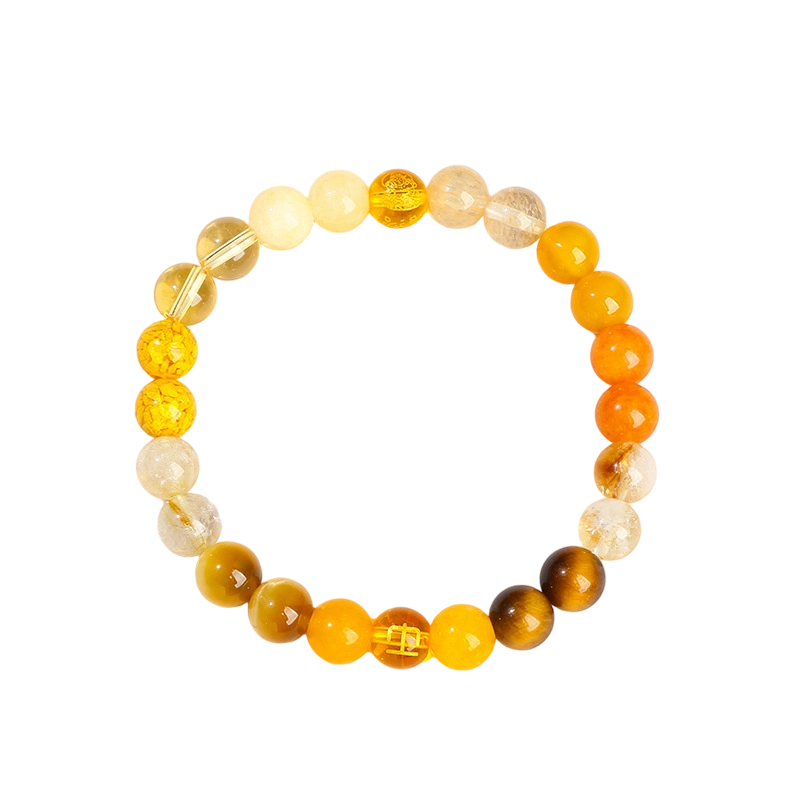
There is a reason citrine has been called the "Merchant's Stone" and the "Success Stone" for centuries — people have long used it as a reminder to stay positive, focused, and action-oriented. If you'd like to carry this energy with you, take a look at our Citrine Bracelet — natural citrine, hand-strung, aligned with the Earth element in the Five Elements system, carrying the meaning of abundance and stability.
Loved this article? Take a deeper guide with you.
Download our free Citrine Mini Guide — a printable PDF with its meaning at a glance, a 2-minute daily ritual, Wu Xing wisdom, and care tips.
4. Citrine Spiritual Meaning & Metaphysical Properties
In spiritual traditions, citrine is closely associated with the Solar Plexus Chakra — the energy center located in the upper abdomen, linked to confidence, personal power, and willpower. It is also associated with the zodiac signs Gemini, Aries, Libra, and Leo, and — along with topaz — serves as the birthstone for November.
On a spiritual level, citrine is believed to stimulate creative energy, inspire optimism, and dispel gloom. It is said to bring positivity and light into one's life, and is considered one of the few crystals with "self-cleansing" properties — meaning it is believed not to accumulate negative energy the way most stones do. In ancient times, Egyptians used citrine as a talisman, while Romans believed it contributed to longevity and happiness, wearing its radiance on their breastplates.
In the Chinese Five Elements (Wu Xing) system, the color yellow belongs to Earth, which resides at the center and symbolizes the earth itself — stability and nourishment. Citrine, with its bright yellow hue, is classified under the Earth element — Earth governs trust, stands at the center, and sustains all things. In Five Elements bracelets, citrine is often used to supplement the Earth element, carrying a wish for stability and abundance. Here, Eastern and Western wisdom converge: citrine is a stone that helps you stand firm, shine, and believe in yourself.
Within the Flow of Elements Five Elements system, citrine belongs to the Earth element — Earth resides at the center, governing stability and nourishment. Not sure which element you are? Take 60 seconds and try our Element Quiz to discover your personal energy profile.
5. How to Wear Citrine
How should you wear citrine? The most common question is: left wrist or right wrist?
In energy traditions, the left wrist is associated with receiving energy, intuition, and inner awareness; the right wrist is associated with action, expression, and projecting energy outward. Specifically:
- Wearing on the left wrist — suited as a personal reminder of confidence, clarity, and focus, or during reflection, planning, and introspection.
- Wearing on the right wrist — suited as a symbol of motivation, action, and forward movement, especially during work, creative projects, or goal pursuit.
That said, there is no strict rule. Many people simply choose whichever wrist feels most comfortable — intention is often considered more important than exact placement. For daily wear, it's best to avoid prolonged exposure to water, remove it before sleeping or exercising, and store it separately to prevent scratches.
There is no absolute right or wrong when it comes to wearing citrine — what matters most is your intention. If you're already considering getting one, our hand-selected Citrine Bracelet features bright, translucent beads on a stretch cord, comfortable and durable for daily wear.
Keep citrine's energy close — on paper.
Loved this article? Take a deeper guide with you.
Download our free Citrine Mini Guide — a printable PDF with its meaning at a glance, a 2-minute daily ritual, Wu Xing wisdom, and care tips.